

Susan Steward
In our March 2026 blog post, we reported on new data from the U.S. Office of Personnel Management (OPM) on federal job losses in the District in 2025. Since March, the data has been updated with revised information, now indicating the loss to the District in 2025 was 32,678 federal jobs, an increase of 1,865 from our last reporting in March. Hiring data was also updated for 2025, reporting 8,508 new hires for District federal jobs, an increase of 51 since the March report. Overall, the District’s estimated federal job change is a net loss of 24,170 jobs in 2025.
However, despite the revised information reporting a higher loss, the District has not recorded a significant drop in income tax receipts from October 2025 to the current month. Table 1 reports a sample from our Monthly Cash Reports of the change in the personal income tax through the month of April.
| Month | Fiscal Year 2026 | Fiscal Year 2025 | % Chg. from Prior Yr |
|---|---|---|---|
| October | $251,330,671 | $222,778,126 | 12.8% |
| November | $222,512,248 | $225,832,587 | -1.5% |
| December | $237,028,806 | $231,263,979 | 2.5% |
| January | $376,937,868 | $330,983,320 | 13.9% |
| February | $254,763,577 | $261,002,038 | -2.4% |
| March | $247,619,206 | $265,152,447 | -6.6% |
| April | $333,881,352 | $314,822,626 | 6.1% |
Source: ORA
As reported in Table 1, despite the significant share of jobs to the District’s economy held by federal government employees, the loss from 2025 appears to be negligent. If the District lost 24,170 jobs, and even a fraction were District residents, we would anticipate a modest decline or lower rate of growth in personal income tax receipts for this fiscal year. However, the loss in the District might be masked by a sizeable factor: severance pay.
Severance Pay and the Curious Case of Withholding Loss
Severance pay is a series of payments made to eligible individuals when there is an involuntary termination, like a reduction in force. Each employer, if severance is offered, may have their own unique established guidelines for who is eligible and how much an employee is entitled to receive upon separation. These payments for tax purposes are treated much like a normal payroll payment, whereby federal, state, and local taxes are withheld each pay period. Historically, severance pay is not extended beyond a few months, and layoffs in a single area do not constitute a significant portion of the workforce to affect prevailing trends. However, in the case of the District, the federal government is a significant employer. As of the 4th quarter of 2024, the federal wages in the District accounted for nearly 28.1 percent of all wages and salaries.Footnote 1 By the 4th quarter of 2025, federal wages accounted for only 25.3 percent of all wages and salaries in the District, a significant drop from the prior year.Footnote 2
This significant drop should be accompanied by a corresponding decline in withholding tax collections, but for the fiscal year to date, we have not recorded such a decline. To understand the better-than-expected performance of withholding tax collections, ORA revisited federal losses by type of separation. Table 2 provides an update on losses by separation type, using revised OPM data through April 2026.
| Separation Type | Total DC Jobs | Total DC Annual Wages |
|---|---|---|
| Quit | 12,689 | $1,799,701,300 |
| Retirement – Voluntary | 9,222 | $1,436,738,481 |
| Reduction in Force (RIF) | 3,725 | $547,958,160 |
| Retirement – Early Out | 3,029 | $489,196,007 |
| Termination (Expired Appt/Other) | 2,670 | $248,732,349 |
| Other Separation | 807 | $95,353,160 |
| Retirement – Other | 536 | $86,948,898 |
| Total | 32,678 | $4,704,628,355 |
Sources: OPM, ORA
As reported in Table 2, the third largest group of losses in 2025 was Reduction in Force (RIF) separations. These separations accounted for 11.4 percent of the total losses for District federal jobs, and 11.6 percent of the total federal wages lost. Unlike a “quit,” where there is usually a last paycheck and possibly 2 additional pay periods, RIFs receive severance pay. As discussed earlier, this severance pay is often paid out over a few weeks – sometimes up to almost a year – and, for tax purposes, is treated much like a paycheck. In the federal government, several factors determine severance pay amounts and duration, including years of federal service and age, and it can have a lifetime maximum of 52 weeks.
Exercise in Federal Severance Pay
When a federal employee is separated through the RIF process, OPM calculates severance pay that will continue to be paid out like payroll to the employee until they have:
- Exhausted their total severance pay amount; or
- Found employment elsewhere.
OPM publishes the calculation methodology for this severance pay on its website. Using this information, along with key data points from the OPM data ORA previously analyzed, we estimate the potential total monthly severance paid out to these employees.
First, the years of service in federal government are key in determining if a newly separated federal employee is eligible to receive severance. If the employee has less than one year of service, they are ineligible. Table 3 reports the total number of federal employees who were separated because of the RIF process in 2025, by “eligible” and “ineligible” based on these criteria, along with their total annual DC wages.
| Eligibility Status | Number of DC Employees | Share of RIF Employees | Total Annual DC WagesFootnote 4 | Share of RIF Employee Wages |
|---|---|---|---|---|
| Eligible | 3,318 | 89.1% | $505,777,400 | 92.3% |
| Ineligible | 407 | 10.9% | $42,180,760 | 7.7% |
| Total | 3,725 | 100% | $547,958,160 | 100% |
Sources: OPM, ORA
As reported in Table 3, ORA identified 3,318 severance-eligible former federal employees who reported to the District in 2025. These employees accounted for roughly $505.8 million, or 92.3 percent, of lost wages associated with the federal layoffs in 2025. However, given their eligibility for severance, the impact from their sudden separation would have been delayed as they received their severance payments.
Next, to estimate the total severance pay allowance, or the maximum amount to be paid, the federal government considers two key factors: years of service and age. For this calculation, an employee is separated based on:
- If their years of service are less than 10 years; or,
- Years of service are greater than 10 years.
The basis for separating based on years of service is the extra credit given to federal employees for each year of service beyond 10 years when calculating their severance pay allowance. Employees with more than 10 years have any years beyond 10 doubled in credit towards their estimate of severance pay allowance. For example, an employee with 20 years would have 10 additional years beyond 10. Thus, their total service for the basis of severance pay allowance is considered 30 years of service.
Additionally, an age adjustment factor is applied if an employee exceeds 40 years of age. This age adjustment is broken down by years and months; however, the actual ages of the employees affected are not available in this dataset. As a result, ORA used the median age adjustment factor for those employees in age brackets 40-44 and higher. In the calculation those younger than 40 years would receive a “1,” but those over 40 have an adjustment factor which is multiplied against their severance pay allowance (increasing their maximum payout).
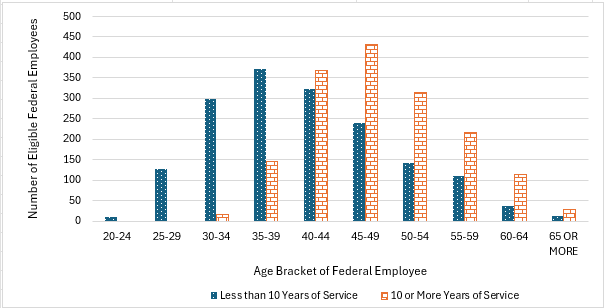
Graph 1 below reports the data by age brackets separated by less than 10 years of service and more than 10 years of service.
Graph 1: Estimated Severance Eligible Federal Employees by Age Bracket Separated by Less or More than 10 Years of Service, 2025
Sources: OPM, ORA
From Graph 1, the concentration of employees with less than 10 years of service was below the age of 40. Therefore, these individuals would be scored with an age adjustment factor of 1. However, those that are above the age of 40 would have a factor greater than 1 and receive a higher maximum severance allowance. Notably, much of that concentration is centered on those with 10 or more years of service. Therefore, the severance would be significantly higher than those with less than 10 years of service as those years exceeding 10 would have counted as double in estimating the base severance allowance. As reported in Table 4, the group with 10 or more years of service also accounted for the larger share of total wages for those separated through the RIF process in 2025.
| Age Bracket | Less than 10 Years of Service | 10 or More Years of Service |
|---|---|---|
| 20-24 | $902,149 | $0 |
| 25-29 | $13,634,909 | $0 |
| 30-34 | $36,780,426 | $2,279,639 |
| 35-39 | $51,131,326 | $22,380,620 |
| 40-44 | $47,218,197 | $60,865,080 |
| 45-49 | $35,889,721 | $72,800,114 |
| 50-54 | $21,179,912 | $54,877,849 |
| 55-59 | $16,335,613 | $38,082,821 |
| 60-64 | $5,615,425 | $19,428,450 |
| 65+ years of age | $1,775,966 | $4,599,183 |
| Total | $230,463,644 | $275,313,756 |
Sources: OPM, ORA
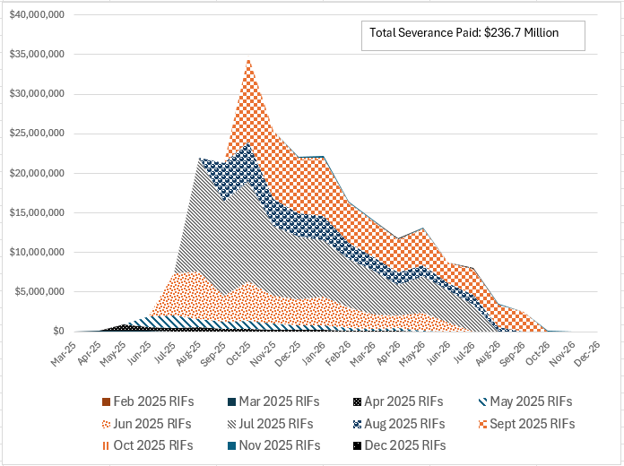
After applying the age adjustment factor and years of service calculations, following the formula from OPM’s estimation worksheet, ORA estimates the total severance to be paid to federal eligible employees with a DC duty station for RIFs in 2025 would be $236.7 million. These payments would be made by the federal government during payroll periods to eligible employees for the duration of their calculated weeks of severance. Since this payment is nearly identical to a regular paycheck, it is subject to all applicable taxes by law. Therefore, if someone is to receive 52 weeks of severance, they would effectively receive payments for a year after separation, and those payments would generate tax revenue over that period. To better understand the duration and size of these payments, Graph 2 reports the totals over a series of months from the period a worker is separated through their allotted severance payment period.
Graph 2: Estimated Severance Paid Out Each Month for 2025 RIF DC Duty Station Federal Employees
Sources: OPM, ORA
As reported in Graph 2, the largest single month of total payouts occurred in October 2025, coinciding with the full impact of the three highest RIF months (July, August, and September). We estimate that the RIFs in July 2025 will account for nearly 38.2 percent of the total severance payments to be made because of the 2025 RIFs. July and September, which accounted for nearly 72.8 percent (2,712 federal employees) of the RIFs for 2025, may also account for $152.4 million in total severance payments. These estimates are based on eligible federal employees taking their entire full severance as permitted.Footnote 5 Furthermore, this would provide insight into why withholding tax growth continues to see positive gains despite the loss of federal employment in the District in 2025.
Concluding Remarks
Despite significant losses in federal employment within the District, income tax withholding collections in fiscal year 2026 continued to grow stronger than initially anticipated. However, we have noted that unemployment remains higher than the national average. In reviewing the OPM data and total reduction in force separations, we anticipate that some of this growth may be temporary as it relates to those receiving severance payments in fiscal year 2026.
Using OPM data and its severance estimation process, we find that 3,318 individuals would be eligible for severance. Of those individuals, 1,638 would receive slightly higher severance payments because their service exceeded 10 years with the federal government. Assuming all eligible federal employees separated through the RIF process with a DC duty station took their full severance, ORA anticipates that $236.7 million will be paid out to all those separated in 2025. We anticipate the highest single-month payout to occur in October 2025 at $34.9 million, with payouts continuing into the late fall of 2026.
What is this data?
The data used in this analysis are publicly available on the Office of Personnel Management's website, by month. ORA downloaded the separate monthly files and tabulated them for the District to analyze the federal employment changes. The data provides information on new federal hiring, separations, and current workforce totals by duty station and agency.